



ADVANCED TOPICS
WHY IT MATTERS
In a world where markets are accelerating, customer expectations are rising and resources are becoming scarcer, one capability determines the long-term success of an organisation: the ability to continuously improve. Not once. Not by chance. But systematically.
Organisations that still rely solely on experience and gut feeling today will fall behind tomorrow. The real question is not whether improvement is necessary, but how to implement it reliably.
This is exactly where Lean Six Sigma comes in.
WHAT IS LEAN SIX SIGMA?
HOW LEAN SIX SIGMA WORKS
Lean Six Sigma combines two proven management philosophies into one powerful methodology.
Lean Management originated in the Japanese automotive industry and has one clear objective:
Eliminate waste. Anything that consumes time and resources without adding value for the customer is systematically identified and removed. Waiting times, unnecessary process steps, excess inventory. Lean makes these hidden cost drivers visible and creates streamlined, efficient workflows.
Six Sigma complements this approach with a data-driven perspective. Instead of relying on assumptions, processes are measured, analysed and improved based on real data. The objective is to minimise defects and ensure consistent, repeatable quality.
The name comes from statistics. Sigma describes process variation, and Six Sigma represents a defect rate of fewer than 3.4 defects per one million opportunities.
Together, both approaches form a structured methodology that makes processes not only faster, but also more reliable and higher in quality.
For organisations, Lean Six Sigma is a genuine competitive advantage. Those who improve processes systematically reduce costs, increase customer satisfaction and enhance delivery reliability, measurably.
Decisions are no longer based on intuition, but on data.
This creates trust, transparency and a culture where improvement is not a temporary initiative, but a mindset.
Organisations that consistently apply Lean Six Sigma respond faster to change, waste less and deliver more reliably. A competitive advantage that is difficult to replicate without the methodology.
For you personally, Lean Six Sigma offers far more than process knowledge. The mindset and tools can be directly applied to your everyday work:
How do I prioritise tasks effectively?
Where am I losing time without realising it?
How do I communicate problems in a way that leads to solutions instead of escalation?
Lean Six Sigma sharpens your focus on what truly matters and positions you not just as a skilled professional, but as someone who actively shapes change rather than passively experiencing it.
WHAT THIS MEANS FOR ORGANISATIONS AND FOR YOU
Lean Six Sigma is not a toolbox that you open once and close again. It is a mindset that, once internalised, fundamentally changes how you see problems, make decisions and achieve results.
WHY THE RIGHT ENTRY POINT MATTERS
Many people interested in Lean Six Sigma start with the same question:
Where should I begin?
Starting too ambitiously creates frustration and drains energy. Starting too cautiously leaves potential untapped.
The truth is, there is no universally correct entry point.
Depending on your experience, your role within the organisation and your goals, there is a level that aligns precisely with where you want to go.
The Lean Six Sigma Belt system was designed for exactly this purpose: to provide a clear, structured development path from foundational understanding to leading complex improvement initiatives.
WHICH BELT LEVEL IS RIGHT FOR ME?
WHICH BELT LEVEL IS RIGHT FOR ME?
Lean Six Sigma is organised into clearly defined certification levels, known as Belts. Each level builds on the previous one, expanding both methodological knowledge and the ability to apply it independently and lead others.
The system is not about titles for their own sake, but about responsibility, depth and impact.
The higher the Belt level, the greater the responsibility for projects, results and people.
WHAT THE INDIVIDUAL LEVELS MEAN AND WHICH ONE FITS YOU
YELLOW BELT, THE AWARE CONTRIBUTOR


The Yellow Belt is your ideal starting point if you want to actively contribute. Here, fundamental tools and methods are not only understood, but applied.
Yellow Belts actively support Green and Black Belt projects, take ownership of smaller sub-projects and develop a genuine understanding of how improvement processes function in practice.
Right for you if:
You want to contribute to projects, improve processes within your immediate work environment and be recognised as a competent contact within your team.
GREEN BELT, THE PROJECT LEADER


The Green Belt marks the transition from contributor to project leader. Green Belts independently lead improvement projects, apply the full DMAIC methodology, Define, Measure, Analyse, Improve, Control, and combine structured thinking with practical implementation capability.
In most organisations, Green Belts drive operational improvement.
Right for you if:
You want to lead projects, take responsibility for measurable results and establish Lean Six Sigma as a core part of your professional role.
BLACK BELT, THE EXPERT AND MENTOR
The Black Belt represents the core of Lean Six Sigma expertise. Black Belts lead complex, organisation-wide initiatives with significant economic impact. They master the methodology at a level that enables them to coach others, solve challenging problems and steer strategic improvement programs.
In many organisations, Black Belt is a dedicated full-time role.
Right for you if:
You aspire to lead process improvement at a strategic level, develop others and take responsibility for enterprise-wide transformation.
MASTER BLACK BELT, THE STRATEGIC LEADER
The Master Black Belt is the highest level within the Belt system. The focus is no longer primarily on individual projects, but on strategy, system design and the development of other Black and Green Belts.
Master Black Belts shape the Lean Six Sigma culture of an organisation and connect operational excellence with strategic leadership.
Right for you if:
You want to drive the transformation agenda of an organisation at executive level and establish Lean Six Sigma as a strategic foundation.
SO WHERE SHOULD YOU START?
Ask yourself three honest questions:
What role do I currently play in my organisation?
What level of responsibility do I want to take on in the future?
How deeply do I want to engage with the methodology?
WHY CHOOSING THE RIGHT LEARNING FORMAT MATTERS
Knowledge alone changes nothing. Anyone who has read a book about fitness without exercising understands this perfectly.
The same applies to professional development. It is not enough to know how something works. What matters is whether you can apply it when it counts.
Many organisations invest heavily in training and then wonder why daily operations remain unchanged. The issue is rarely the content itself.
Training and coaching are fundamentally different approaches, each with distinct strengths, objectives and moments where they create real impact. Understanding this difference allows you to make better decisions about how to develop yourself or your team.
COACHING VS. TRAINING
HOW TRAINING AND COACHING DIFFER
Training is structured knowledge transfer. It follows a defined curriculum, teaches methods, concepts and tools, and establishes a shared level of understanding among participants.
Training is repeatable, scalable and ideal for laying foundations or introducing a consistent methodology across a team.
A good training answers the question:
What do I need to know?
Coaching begins where training ends. It is not about general knowledge, but about your specific situation, your challenges, your blind spots and your next steps.
A coach supports you in transferring what you have learned into your practical reality and helps you overcome obstacles that no textbook can anticipate.
Effective coaching answers the question:
How do I apply this in my specific context?
WHAT THIS MEANS IN PRACTICE AND WHEN TO CHOOSE WHICH APPROACH
Choose training when you or your team need a strong methodological foundation. When new concepts are introduced, terminology is aligned or tools are learned for the first time, training is the right choice. It creates a shared language, and that is the prerequisite for everything that follows.
In the context of Lean Six Sigma, this means a Green Belt training equips you with the DMAIC methodology, relevant tools and essential statistical knowledge. By the end, you understand how to structure an improvement project.
Choose coaching when you are leading a real project, feel stuck or want to ensure that your knowledge translates into measurable results. Coaching helps you apply the right tools at the right time and gives you the confidence to navigate complex situations effectively.
In Lean Six Sigma terms, this could mean you have completed your training and are now leading your first project, supported by an experienced coach who helps you interpret data correctly, guide your team and manage setbacks constructively.
The most powerful approach combines both.
Training lays the foundation.
Coaching builds on it.
Those who combine both learn faster and more sustainably. Knowledge tested, reflected upon and adapted in real situations becomes lasting capability.
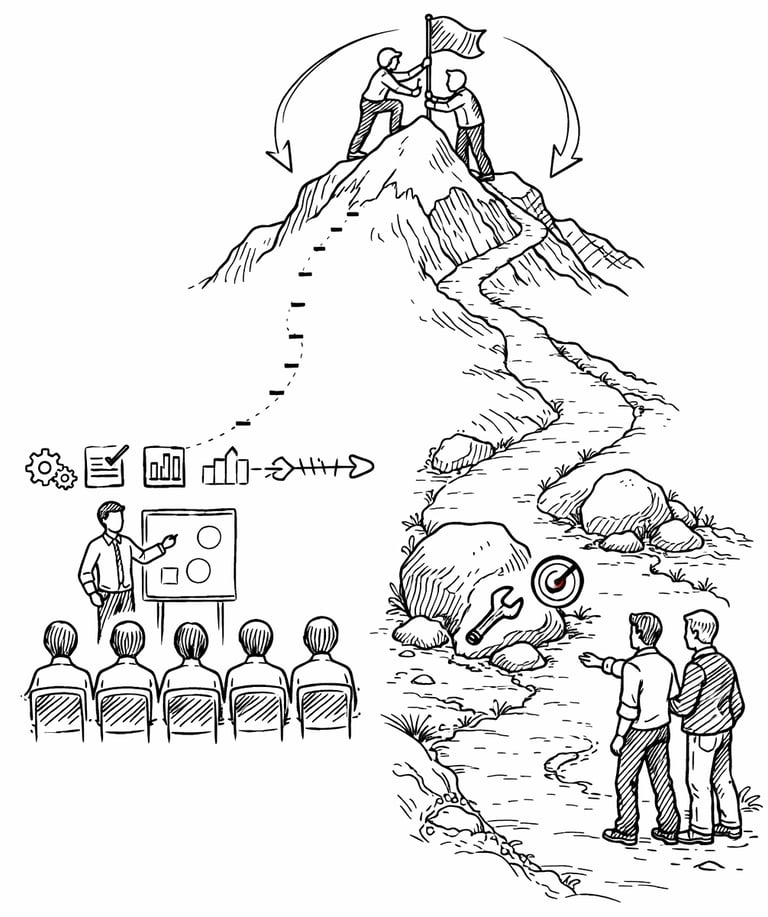
TRAINING
COACHING
YOUR SUCCESS
ADVANCED TOPICS
WHY IT MATTERS
In a world where markets are accelerating, customer expectations are rising and resources are becoming scarcer, one capability determines the long-term success of an organisation: the ability to continuously improve.
Not once. Not by chance. But systematically.
Organisations that still rely solely on experience and gut feeling today will fall behind tomorrow.
The real question is not whether improvement is necessary, but how to implement it reliably.
This is exactly where Lean Six Sigma comes in.
WHAT IS LEAN SIX SIGMA?
HOW LEAN SIX SIGMA WORKS
Lean Six Sigma combines two proven management philosophies into one powerful methodology.
Lean Management originated in the Japanese automotive industry and has one clear objective:
Eliminate waste.
Anything that consumes time and resources without adding value for the customer is systematically identified and removed. Waiting times, unnecessary process steps, excess inventory. Lean makes these hidden cost drivers visible and creates streamlined, efficient workflows.
Six Sigma complements this approach with a data-driven perspective. Instead of relying on assumptions, processes are measured, analysed and improved based on real data. The objective is to minimise defects and ensure consistent, repeatable quality.
The name comes from statistics. Sigma describes process variation, and Six Sigma represents a defect rate of fewer than 3.4 defects per one million opportunities.
Together, both approaches form a structured methodology that makes processes not only faster, but also more reliable and higher in quality.
For organisations, Lean Six Sigma is a genuine competitive advantage. Those who improve processes systematically reduce costs, increase customer satisfaction and enhance delivery reliability, measurably.
Decisions are no longer based on intuition, but on data.
This creates trust, transparency and a culture where improvement is not a temporary initiative, but a mindset.
Organisations that consistently apply Lean Six Sigma respond faster to change, waste less and deliver more reliably. A competitive advantage that is difficult to replicate without the methodology.
For you personally, Lean Six Sigma offers far more than process knowledge. The mindset and tools can be directly applied to your everyday work:
How do I prioritise tasks effectively?
Where am I losing time without realising it?
How do I communicate problems in a way that leads to solutions instead of escalation?
Lean Six Sigma sharpens your focus on what truly matters and positions you not just as a skilled professional, but as someone who actively shapes change rather than passively experiencing it.
WHAT THIS MEANS FOR ORGANISATIONS AND FOR YOU
Lean Six Sigma is not a toolbox that you open once and close again. It is a mindset that, once internalised, fundamentally changes how you see problems, make decisions and achieve results.
WHY THE RIGHT ENTRY POINT MATTERS
Many people interested in Lean Six Sigma start with the same question:
Where should I begin?
Starting too ambitiously creates frustration and drains energy. Starting too cautiously leaves potential untapped.
The truth is, there is no universally correct entry point.
Depending on your experience, your role within the organisation and your goals, there is a level that aligns precisely with where you want to go.
The Lean Six Sigma Belt system was designed for exactly this purpose: to provide a clear, structured development path from foundational understanding to leading complex improvement initiatives.
WHICH BELT LEVEL IS RIGHT FOR ME?
HOW THE BELT SYSTEM IS STRUCTURED
Lean Six Sigma is organised into clearly defined certification levels, known as Belts. Each level builds on the previous one, expanding both methodological knowledge and the ability to apply it independently and lead others.
The system is not about titles for their own sake, but about responsibility, depth and impact.
The higher the Belt level, the greater the responsibility for projects, results and people.
WHAT THE INDIVIDUAL LEVELS MEAN AND WHICH ONE FITS YOU
YELLOW BELT, THE AWARE CONTRIBUTOR
The Yellow Belt is your ideal starting point if you want to actively contribute. Here, fundamental tools and methods are not only understood, but applied.
Yellow Belts actively support Green and Black Belt projects, take ownership of smaller sub-projects and develop a genuine understanding of how improvement processes function in practice.
Right for you if:
You want to contribute to projects, improve processes within your immediate work environment and be recognised as a competent contact within your team.
GREEN BELT, THE PROJECT LEADER
The Green Belt marks the transition from contributor to project leader. Green Belts independently lead improvement projects, apply the full DMAIC methodology, Define, Measure, Analyse, Improve, Control, and combine structured thinking with practical implementation capability.
In most organisations, Green Belts drive operational improvement.
Right for you if:
You want to lead projects, take responsibility for measurable results and establish Lean Six Sigma as a core part of your professional role.
BLACK BELT, THE EXPERT AND MENTOR
The Black Belt represents the core of Lean Six Sigma expertise. Black Belts lead complex, organisation-wide initiatives with significant economic impact. They master the methodology at a level that enables them to coach others, solve challenging problems and steer strategic improvement programs.
In many organisations, Black Belt is a dedicated full-time role.
Right for you if:
You aspire to lead process improvement at a strategic level, develop others and take responsibility for enterprise-wide transformation.
MASTER BLACK BELT, THE STRATEGIC LEADER
The Master Black Belt is the highest level within the Belt system. The focus is no longer primarily on individual projects, but on strategy, system design and the development of other Black and Green Belts.
Master Black Belts shape the Lean Six Sigma culture of an organisation and connect operational excellence with strategic leadership.
Right for you if:
You want to drive the transformation agenda of an organisation at executive level and establish Lean Six Sigma as a strategic foundation.
SO WHERE SHOULD YOU START?
Ask yourself three honest questions:
What role do I currently play in my organisation?
What level of responsibility do I want to take on in the future
How deeply do I want to engage with the methodology?
WHY CHOOSING THE RIGHT LEARNING FORMAT MATTERS
Knowledge alone changes nothing. Anyone who has read a book about fitness without exercising understands this perfectly.
The same applies to professional development. It is not enough to know how something works. What matters is whether you can apply it when it counts.
Many organisations invest heavily in training and then wonder why daily operations remain unchanged. The issue is rarely the content itself.
Training and coaching are fundamentally different approaches, each with distinct strengths, objectives and moments where they create real impact. Understanding this difference allows you to make better decisions about how to develop yourself or your team.
COACHING VS. TRAINING
HOW TRAINING AND COACHING DIFFER
Training is structured knowledge transfer. It follows a defined curriculum, teaches methods, concepts and tools, and establishes a shared level of understanding among participants.
Training is repeatable, scalable and ideal for laying foundations or introducing a consistent methodology across a team.
A good training answers the question:
What do I need to know?
Coaching begins where training ends. It is not about general knowledge, but about your specific situation, your challenges, your blind spots and your next steps.
A coach supports you in transferring what you have learned into your practical reality and helps you overcome obstacles that no textbook can anticipate.
Effective coaching answers the question:
How do I apply this in my specific context?
WHAT THIS MEANS IN PRACTICE AND WHEN TO CHOOSE WHICH APPROACH
Choose training when you or your team need a strong methodological foundation. When new concepts are introduced, terminology is aligned or tools are learned for the first time, training is the right choice. It creates a shared language, and that is the prerequisite for everything that follows.
In the context of Lean Six Sigma, this means a Green Belt training equips you with the DMAIC methodology, relevant tools and essential statistical knowledge. By the end, you understand how to structure an improvement project.
Choose coaching when you are leading a real project, feel stuck or want to ensure that your knowledge translates into measurable results. Coaching helps you apply the right tools at the right time and gives you the confidence to navigate complex situations effectively.
In Lean Six Sigma terms, this could mean you have completed your training and are now leading your first project, supported by an experienced coach who helps you interpret data correctly, guide your team and manage setbacks constructively.
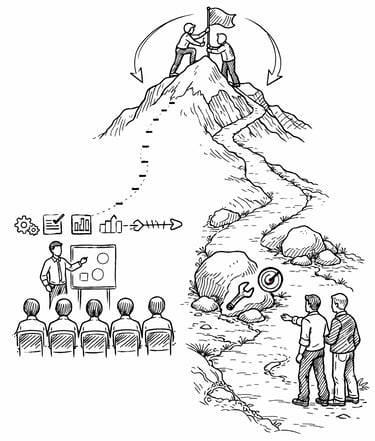
TRAINING
COACHING
YOUR SUCCESS
Bock & Kohl TRANSFORM2BEST GbR
Nordring 6
47918 Tönisvorst
Germany
REPRESENTED BY:
Thorsten Bock
Tobias Kohl
NOTICE ACCORDING TO § 19 UStG:
As a small business within the meaning of Section 19 of the German Value Added Tax Act, no VAT is charged and therefore none is shown.
CONTACT
Phone: +49 (0) 172 136 057 9
E-Mail: transform2best.coaching@gmail.com
© 2026 Bock & Kohl TRANSFORM2BEST GbR – All rights reserved.