


Why Lean Six Sigma Still Wins in the Age of AI - A Practical Competitive Advantage
Lean Six Sigma gives AI the foundation it needs, clear processes, clean data, measurable targets, and strong change leadership. Learn how to combine DMAIC and AI for lasting performance.
5/8/20246 min read
AI is moving fast, and so are the expectations inside organisations. Leaders want productivity gains, better customer experiences, faster decisions, and new growth. Many teams respond by rushing into tools, pilots, and automations.
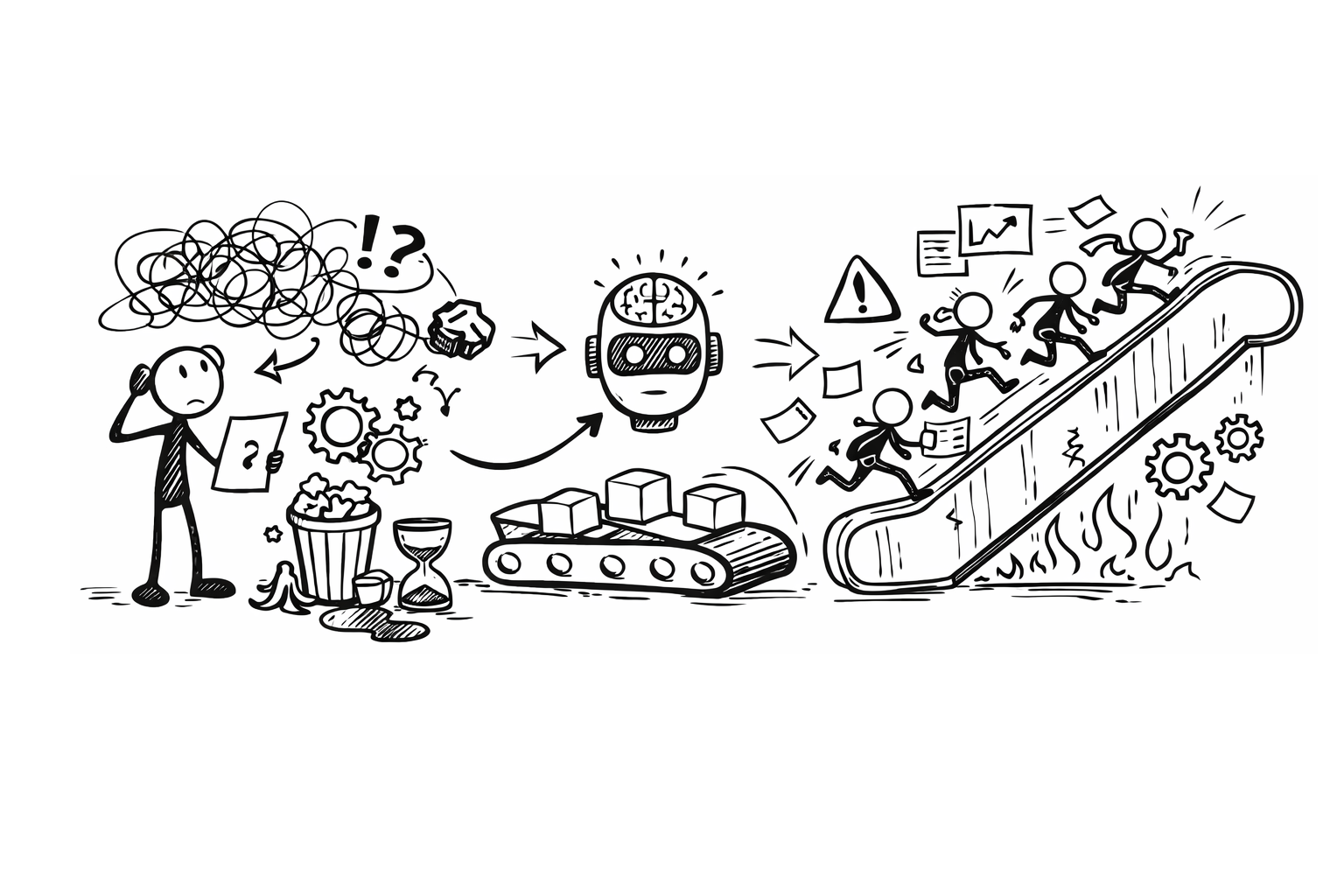
The problem is simple. If the underlying process is unclear, inconsistent, or full of waste, AI will not magically fix it. It will often scale the dysfunction faster.
Why Lean Six Sigma Still Delivers a Major Competitive Advantage in the Age of AI
That is exactly why Lean Six Sigma is not “old school” in an AI world. It is the operating system that makes AI deployments measurable, scalable, and sustainable.
Bill Gates summed up the core idea years ago, automation applied to an efficient operation magnifies the efficiency, automation applied to an inefficient operation magnifies the inefficiency.
Lean Six Sigma is how you make sure your operation is the efficient one.
1. AI automation only works when the process is already clear
AI thrives on patterns. If your process has multiple unofficial variants, hidden rework loops, unclear decision rules, or inconsistent handovers, then you do not have one process. You have many, and AI will amplify the inconsistency.
Lean Six Sigma brings clarity before automation through practical, visual, and data driven methods, for example process mapping, SIPOC, value stream thinking, and standard work. The goal is not documentation for its own sake. The goal is a stable, repeatable flow that you can improve and then automate with confidence.
This is also why many automation and transformation programs stall, not because the technology is weak, but because the process and adoption foundations are weak.
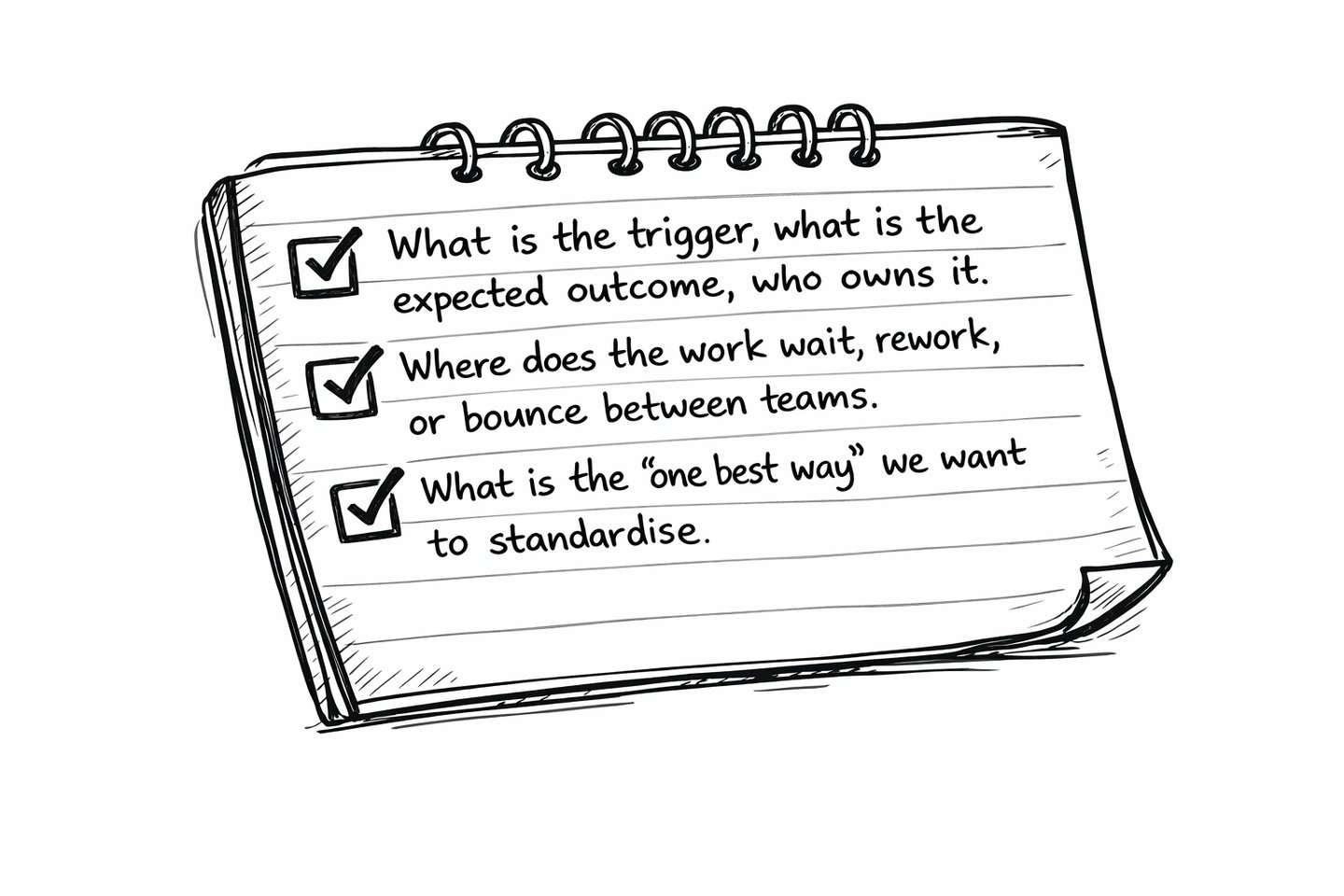
Before you automate anything with AI, be able to answer three questions in plain language.
What is the trigger, what is the expected outcome, who owns it.
Where does the work wait, rework, or bounce between teams.
What is the “one best way” we want to standardise.
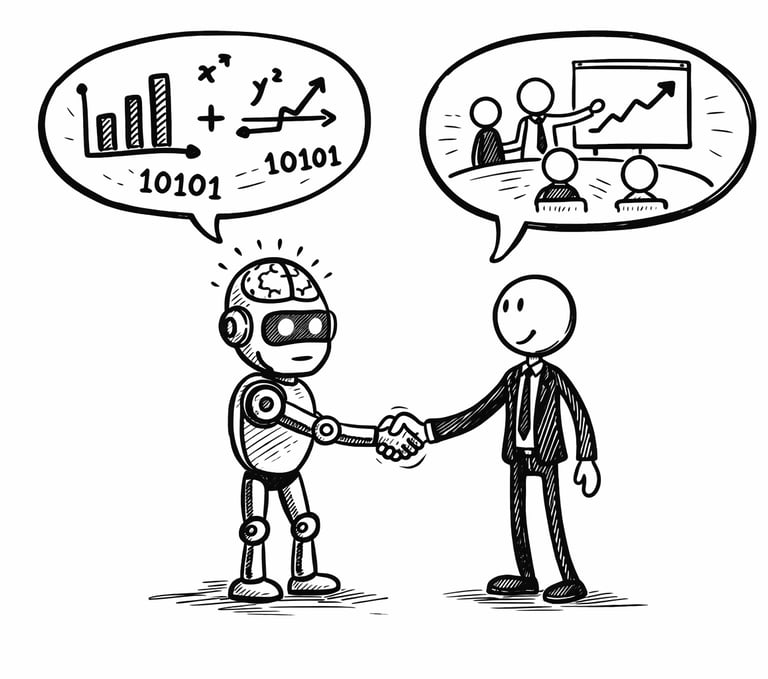
2. “Human in the loop” is not optional, it is the advantage
AI is excellent at generating options, detecting patterns, summarising information, and supporting decisions. But most organisations do not win because they produced more insights. They win because they translated insights into real world execution, safely, ethically, and consistently.
That translation is human work.
It includes judgement, trade offs, risk decisions, context that is not in the data, and leadership. Research and practitioner guidance repeatedly emphasise that humans and AI are often strongest together, especially when work requires context, nuance, and decision making beyond pattern recognition.
Lean Six Sigma strengthens the human part through.
Clear roles and decision rights.
Visual management and daily accountability.
Problem solving routines that turn findings into actions.
A culture of continuous improvement, not tool chasing.
3. Change management and leadership make AI stick
Even a brilliant AI solution fails if people do not adopt it, trust it, or know how to use it. This is where Lean Six Sigma’s deployment mindset, governance, and leadership routines become a decisive edge.
Change management is widely described as managing the people side of change, because without adoption you do not get outcomes.
Lean Six Sigma supports adoption through.
Stakeholder alignment, Voice of the Customer, CTQs, and clear benefits.
Transparent measurement, so teams can see if the change is helping.
Control plans and standard work, so gains do not evaporate.
Coaching, capability building, and leader standard work.
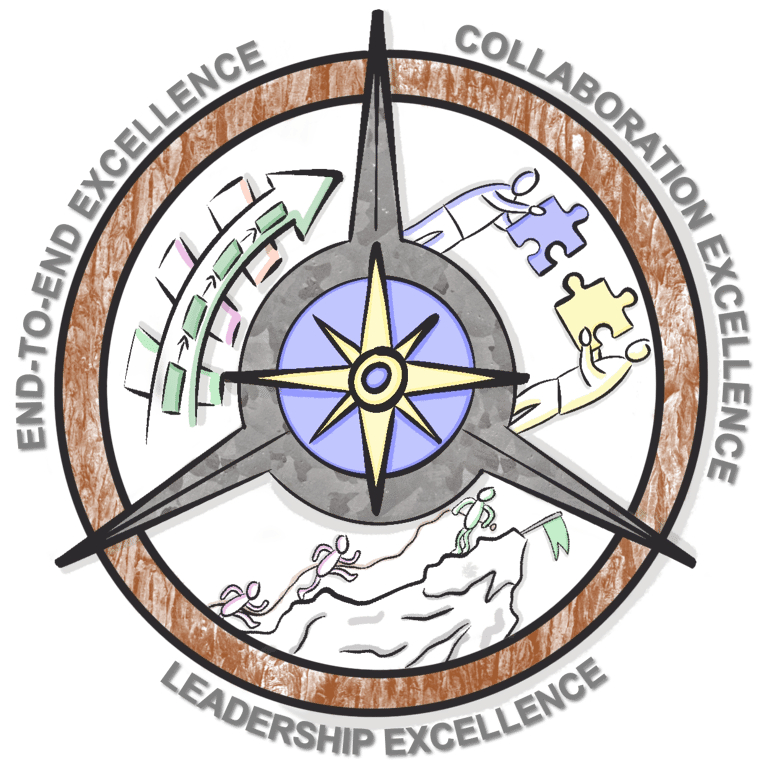
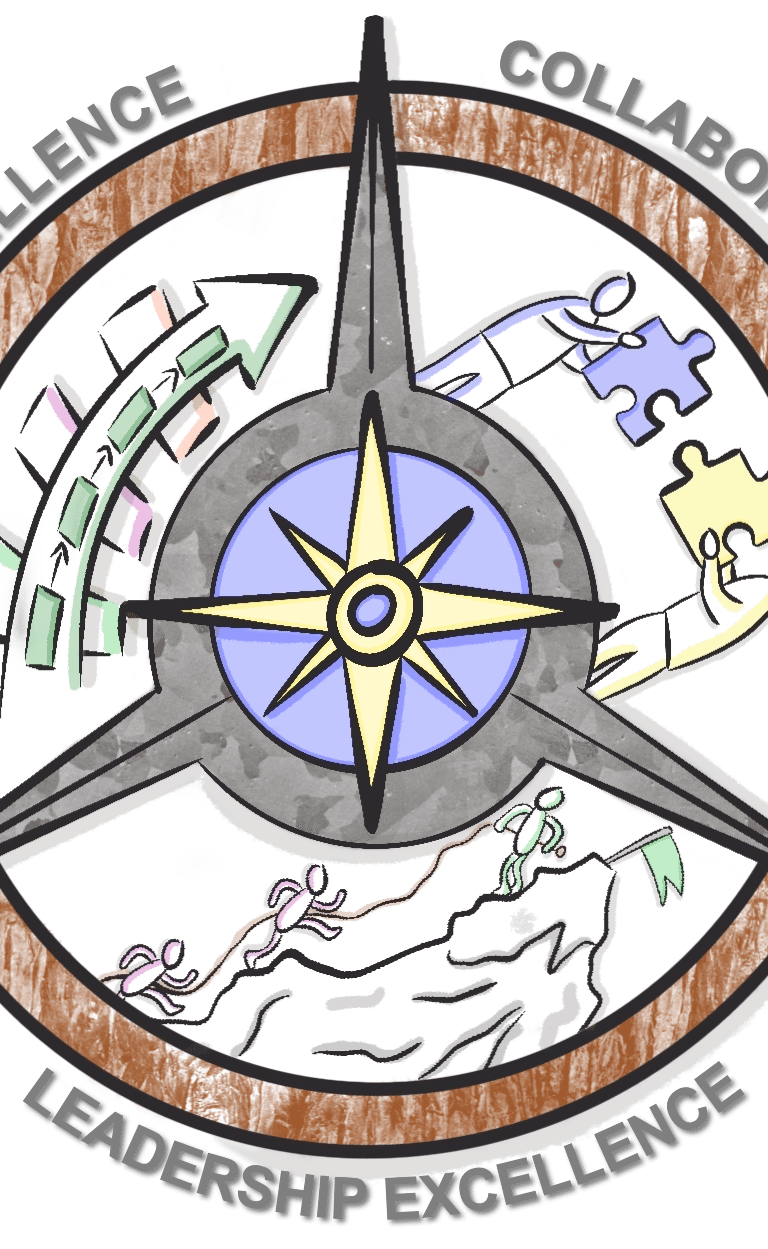
For this reason we at TRANSFORM2BEST offer a holistic approach that covers Lean Six Sigma Tools, Change Management, Leadership skills & Collaboration Excellence.
4. DMAIC gives AI a measurable business mission
A common failure mode in AI programs is “solution first”. A model is built, a dashboard is launched, and then the business asks, so what changed.
DMAIC prevents that by forcing clarity on purpose and measurement.
DMAIC is a structured problem solving approach used to improve existing processes, Define, Measure, Analyse, Improve, Control.
Define, choose the right AI use case: AI use cases become powerful when they are tied to a clear CTQ, a business KPI, and a specific pain point. Define also helps you avoid automating the wrong thing.
Helpful Lean Six Sigma tools, VOC, CTQ tree, SIPOC, problem statement, project charter.
Where AI helps, rapid synthesis of VOC themes, drafting stakeholder maps, generating hypothesis lists.


D
M
A
Here is how AI fits into each phase.
Measure, make reality visible: AI needs clean, relevant data, but measurement is bigger than data extraction. You need operational definitions, a baseline, and clarity on what “good” looks like.
Helpful tools, data collection plan, MSA where relevant, baseline capability, lead time measurement.
Where AI helps, anomaly detection, automated data validation, faster descriptive analytics.
Analyse, find the true drivers: AI can accelerate analysis, but Lean Six Sigma keeps you honest about causality and operational reality.
Helpful tools, Pareto, fishbone, 5 Whys, hypothesis testing, regression where appropriate.
Where AI helps, pattern mining across logs, clustering issue types, identifying leading indicators.
I
C
Improve, design solutions that work on the floor: This is the “translation to reality” phase. Humans matter most here. AI can propose options, but the team must validate feasibility, safety, customer impact, and process fit.
Helpful tools, solution selection matrix, piloting, FMEA, Kaizen.
Where AI helps, generating countermeasure options, drafting SOPs, simulating scenarios.
Control, lock in the gains: The competitive advantage is not the pilot. It is sustained performance. Control is where many AI initiatives under invest.
Helpful tools, control plan, visual management, process confirmation, standard work, training plan.
Where AI helps, monitoring drift, automated alerts, continuous KPI reporting.
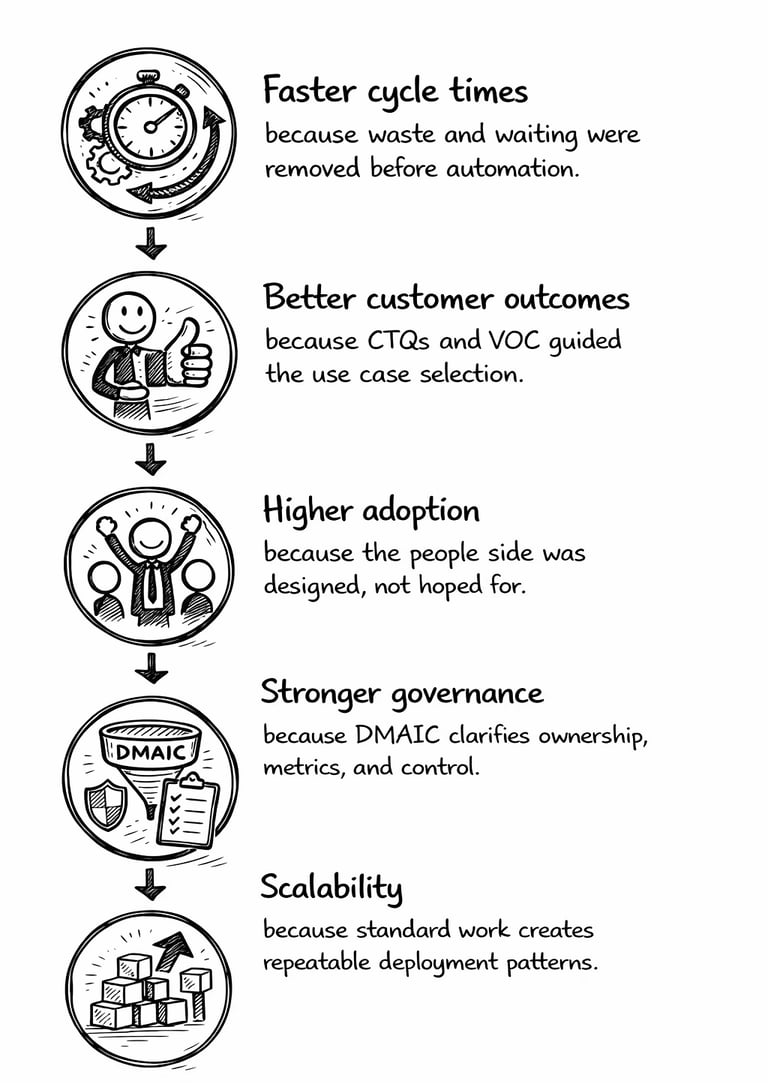
5. What “competitive advantage” looks like in an AI era
When Lean Six Sigma and AI are combined well, the advantage is not just speed. It is reliability.
6. A practical playbook, Lean Six Sigma first, then AI
Use this sequence to reduce risk and improve ROI:
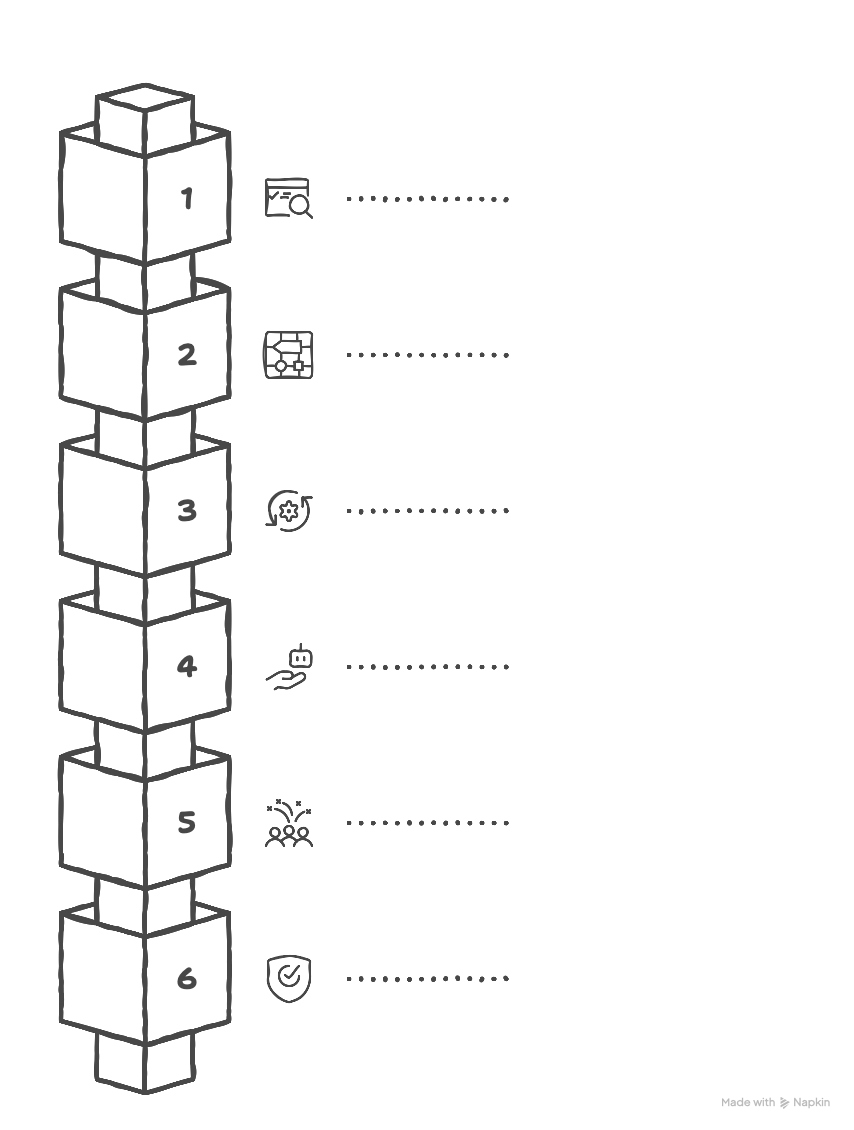
Pick a Process
Identify a critical process tied to customer outcomes and business KPIs.
Map the Flow
Analyse the current process to find waste and clarify decision rules.
Stabilise the Work
Standardise the process and remove rework loops.
Define AI Role
Determine how AI will assist, recommend, automate, or monitor the process.
Pilot with Users
Test the AI solution with frontline users and measure its impact.
Lock in Control
Establish training, ownership, monitoring, and continuous improvement.
Ready to make AI work in your business, not against it?
At TRANSFORM2BEST, we help you get the fundamentals right first…then we help you accelerate.
Through our Lean Six Sigma Trainings, Project Management courses, and Leadership programs and coachings, you will.
Clarify priorities and define the right improvement targets.
Remove waste and stabilise the way work gets done.
Build capability in your team, so improvements stick.
Create measurable outcomes, so every AI investment has a real business case.
If you want a reliable partner who combines structured methods with practical implementation, we would love to support you.
Explore our trainings and coachings, and let’s map your next improvement step.
LEAN SIX SIGMA TRAININGS & COACHING


PROJEKTMANAGEMENT COACHING
LEADERSHIP & EXECUTIVE COACHING
Bock & Kohl TRANSFORM2BEST GbR
Nordring 6
47918 Tönisvorst
Germany
REPRESENTED BY:
Thorsten Bock
Tobias Kohl
NOTICE ACCORDING TO § 19 UStG:
As a small business within the meaning of Section 19 of the German Value Added Tax Act, no VAT is charged and therefore none is shown.
CONTACT
Phone: +49 (0) 172 136 057 9
E-Mail: transform2best.coaching@gmail.com
© 2026 Bock & Kohl TRANSFORM2BEST GbR – All rights reserved.